Sunday, January 25, 2009

Hawaiian Trip & Food


It snowed again here on Beacon Hill. It's not sticking, but it sure does make me look forward to our three week long trip to the islands this June to celebrate our 1st Anniversary. We're going to revisit some of the places in Honolulu I saw as a child and many new places, and then we're going to return to the house in Hilo we were married in last June for a few days, then spend the remaining two weeks in a vacation home down near the Kapoho tidepools, on the South-East corner of the Big Island. I can't wait! It feels good on these cold Seattle winter days to think ahead to flip-flops and shorts, snorkeling, Mai tais, and getting to cook with amazing fresh produce and fish.


In the meantime, we'll be cooking up plenty of Hawaiian food here at home. Check out past posts tagged with 'Hawaiian' on my food blog for everything from very traditional fish & poi, fun recipes like mai tai cupcakes, and my recent post on our Sunday dinner of ahi katsu & coconut shrimp.

Saturday, December 27, 2008

Book Review: Moloka`i

I mentioned in my review of Honolulu that I had been reading Alan Brennert's previous historical novel, Moloka`i. I finished it about a week ago, but have been distracted by the inclement weather here in Seattle as well as the usual holiday craziness.

Published in 2004, Moloka`i tells the story of a girl named Rachel who is diagnosed with Hansen's disease (then referred to as "leprosy") at age seven and send away to Kalaupapa, a peninsula-colony on the island of Moloka`i for quarantined patients and their caretakers.

As he did in Honolulu, Brennert quickly creates vivid back stories for each of the characters while staying closely connected to the psychology of Rachel. The novel spans decades, as Rachel grows to be a teen, a young woman, a wife, and even briefly a mother in a bittersweet chapter of her life. Being one of the settlement's healthier patients, Rachel outlives almost all those who become her family. This provided her with an oppressive amount of time to reflect. As her father was a seamen, Rachel held on to the constant dream of exploring the world -- the world outside Hansen's disease.

I found Moloka`i to be more painful to read at times, as its elegiac subject matter resonated emotions within, ranging from pure melancholy to utter rage at the injustices of the situation. Ultimately, I was a bit more affected emotionally by the story though I found Honolulu a bit more hopeful and inspiring.

In both cases, Brennert shows a clear talent for understanding women and their desires. Both his heroines were at once strong, struggling, unsure and nothing shy of human. Brennert also underlines certain themes in both novels, including ideas of entrapment, injustice and deferred gratification in the eye of mammoth obstacles.

I highly recommend reading both novels. This one brought me back to my own time on the ethereal island of Moloka`i. We were there just one week back in 2006, but it definitely struck me as having mana like no other place on Earth. With that comes a deep linger....

Thursday, December 4, 2008

Book Review: Honolulu

I recently had the privilege of reading an advanced copy of Alan Brennert's new historical novel, simply titled Honolulu. It is the follow-up to Brennert's Moloka`i, his first foray into Hawaiian historical fiction (I am reading this right now, and will eventually post a review of it, too).

Honolulu is a harrowing tale of overcoming one's destiny, thwarting convention and ultimately living out the dream that is at once American and Hawaiian. It is the story of Jin, a once shunned Korean girl named "Regret" by her parents for not being a boy and destined to a life decided on her behalf. She would wed a man chosen by her family, become a wife and mother, and never learn to read or leave her quarters of the house.

But Jin had other ideas. As a young girl at the turn of the century, she found a piece of a book that had blown into her yard. She made her brother read it, and she began teaching herself how to read. Constantly longing for an education and life of purpose, Jin one day learned of a place called Hawai`i, where everything was beautiful and the streets "paved with gold." She and her best friend began flirting with the notion of becoming picture brides. It was their only ticket out of Korea, to a new life. While her family frowned upon her idea and her father shunned her for learning how to read, Jin simply could not stay trapped.

Of course, Jin's journey would not be so simple as an immediate marriage into the American dream. She and the other picture brides would quickly discover that the handsome and ostensibly prosperous men who chose them were much older than their pictures would illustrate, and most were plantation workers. Worst, though, was Jin's husband's appetite for violence. After fleeing her doomed destiny in Korea, had she traveled all this way only to find a lot much more devastating?

From here, the novel finds its strongest footing, and assuredly moves through Jin's inspiring decisions that define her future, and her life. Along the way she befriends prostitutes, gets cozy with police officers, becomes an enterprising seamstress, and finds true love and fortune in a land that becomes intertwined with her new identity. One particular part of Jin's story I found moving involved her confronting her own prejudice against the Japanese, who had ripped her native country from her people. During the Depression, she befriends a Japanese woman and tentatively begins to help her, despite her own misgivings. It is a slow process, but over time, Jin comes to her own realization that it is no longer about Korea or Japan...they are all Hawaiians now.

Not without tragedy, Honolulu is a fundamental testament to the possibility of creating your own life by never extinguishing that fire crackling with dreams, determination, and resiliency.

At the end of her story, Jin reflects on her new home: "Hawai`i has often been called a melting pot, but I think of it more as a "mixed plate" -- a scoop of rice with gravy, a scoop of macaroni salad, a piece of mahi-mahi, and a side of kimchi. Many different tastes share the plate, but none of them loses its individual flavor, and together they make up a uniquely "local" cuisine. This is also, I believe, what America is at its best -- a whole great than the sum of its parts."

Jin reunites with the other picture brides in Honolulu, and they begin meeting on a regular basis, and eventually form a kye. A kye is essentially a pot of money that each member contributes to, and periodically requests to draw from it. Everyone votes, and decides if this is a reasonable use of the funds. From these funds, each of the women is able to lead a better life. Businesses are started. Real estate is purchased. Jin leaves behind her family in Korea, and with it much of the old ways. In Hawai`i, though, she makes her own family and has experiences one could only have in those great Pacific islands.

In times of unprecedented uncertainty in the world, I cannot convey enough the value in reading this novel. Jin found that in Hawai`i the roads were not paved with gold, and life would not be without major obstacles. Yet, she found a way to survive and in the end, made her own version of Paradise. The idea of 'Paradise as Possibility' should resonate with anyone still feeding that crackling fire.

Big Island-Big Island

We have come across yet another Big Island resource!

The site "Big Island-BigIsland" is quite impressive, with a daily-updated blog, information on sovereignty, accommodations, restaurants, politics and island life in general.

Check it out!

Healthy Hawai`i

According to the 19th Annual State rankings put together by various groups, Hawai`i is the second healthiest state in the Union. With the availability of fresh seafood and produce, and wide range of outdoor activities, we are far from surprised. Maika`i!


The full article is here.

Tuesday, November 18, 2008

2008 Winter Pineapple Classic

We first posted about this on October 5th.

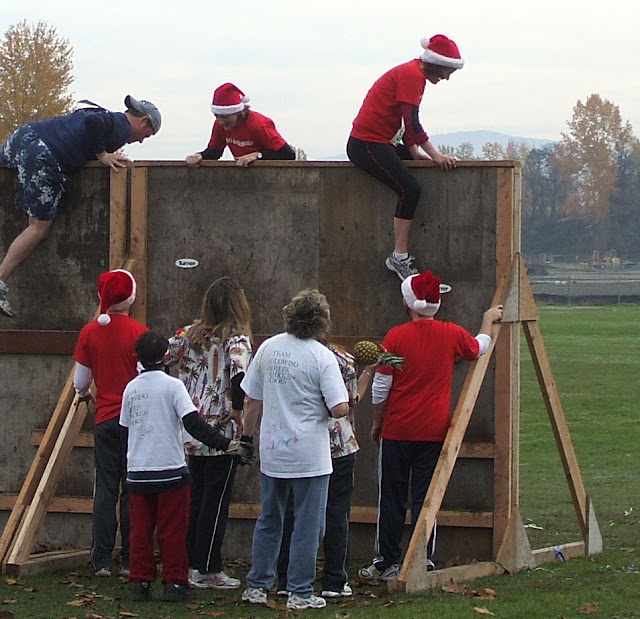
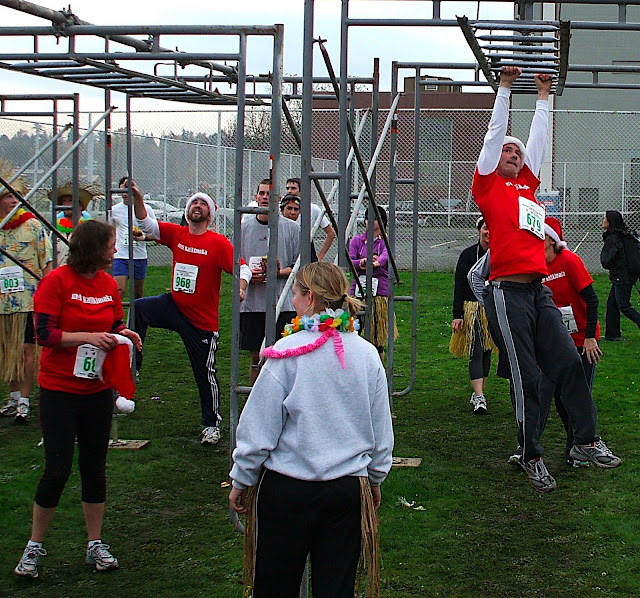
This past Sunday we ran in the Pineapple Winter Classic, a 5K run with obstacles in Seattle's Magnuson Park that raises money for the Leukemia and Lymphoma Society. What separates this from just any other run for charity? People dress up in Hawaiian-themed costumes! We saw face-painted warriors, hula girls and plenty of hibiscus-inspired teamware.

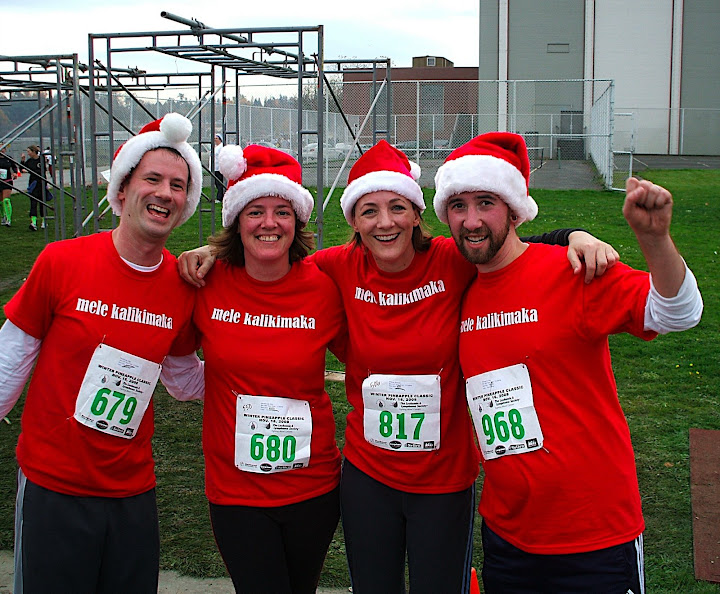
Our team name was "Mele Kalikimaka," (Merry Christmas in Hawaiian) and we wore bright red shirts with our team name and Santa hats.


Some of the obstacles proved to be quite challenging, including ducking down into barrels, scaling walls and the mighty monkey bars that proved to require intense upper body strength.


According to the WPC website, turnout doubled from last year. We had a blast, and when times got tough we'd just remind ourselves of the luau and beer garden near the finish line.

Our friends Jerry and Warren greeted us as we made our way to the final leg, and we all enjoyed a refreshing brew in the beer garden. An entire hangar had been convereted to a luau setting, complete with real sand, a volleyball net and a stage where entertainers performed traditional Hawaiian music. Our friend Gary Medeiros was one of them!

Because of our late start-time (12:40), there wasn't much in the way of food left by the time we hit the buffet line. However, we were able to scarf down some noodles and salad before hoofing it back to our car.

The weather was gorgeous, making the run all the more enjoyable. Running with family for a great cause, with the rewards of Hawaiian culture? Not too many better ways to spend a Sunday afternoon.

Aloha!

Sunday, November 2, 2008

Music & Food in Georgetown

Last Saturday we ventured down to the Georgetown neighborhood, to the Kaua`i Family Restaurant. Our friend Gary Medeiros was performing with Auntie Manu from 11am-2pm. We stopped in after running some Saturday morning errands for some `ono breakfast and mele.

Gary plays the ukulele and sings the male falsetto. He is quite good! He and Auntie Manu make a great team, and we found out they will both be performing at the luau celebration after the Pineapple Classic Run we're doing on November 16th at Magnuson Park. And the Kaua`i Family Restaurant is catering. What a preview!

I had the standard Hawaiian breakfast (eggs with rice and Portuguese sausage) while Dan went for the loco moco w/ spam. We were both pleased with the low-priced and hearty plates, but the star of the meal had to be the bag of malasadas we snagged right as we ordered. Malasadas are a Portuguese donut - basically like a donut but 100 times better! The restaurant only serves them on the weekends and they sell out quickly. In fact, we saw many folks just coming in to order a bag of them to go. We took the rest home and ate them the next day.

The performance was lively, as the two sang many Hawaiian favorites including Iz's "Somewhere Over the Rainbow." At times some of the patrons got up and performed an impromptu hula. It was fun to watch.

It turns out Gary and his partner are part of a halau with Auntie Manu that meets on Sundays, informally, so we are going to try our hands - er - waists at hula soon!

We unfortunately forgot the camera.

Tomorrow night we are headed to the Open House/sneak preview of the holiday line at the Hawai`i General Store and will hopefully remember to snap some pics to share.